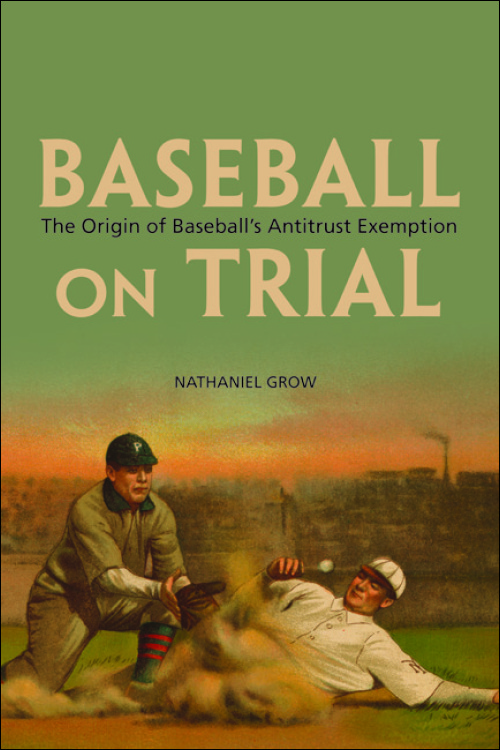
This is the first in a series of posts discussing my research into the history of the 1922 U.S. Supreme Court case of Federal Baseball Club of Baltimore v. National League, culminating in my recently released book, Baseball on Trial: The Origin of Baseball's Antitrust Exemption.
One hundred years ago, professional baseball was in a state of turmoil. The two major leagues, the American and National, were facing a challenge to their supremacy from the rival Federal League. After completing its initial season in 1913 employing mostly semi-professional and former pro players, the Federal League announced its intentions to elevate itself to major league status in 1914 by signing major league players away from their current clubs. The Federal League believed it could do this based on advice from its legal counsel, who had determined that the existing standard major league player contract was legally unenforceable due to two provisions: the reserve clause and the ten-day release provision. The reserve clause assigned each team the automatic right to renew its players' contracts for the following season, effectively tying players to their current teams for the entire length of their careers. Meanwhile, the ten-day release provision allowed teams to release their players for any reason at all simply by providing them with ten days notice.
The Federal League's attorneys believed that these two provisions, taken in combination, rendered the players' contracts legally unenforceable due to a lack of mutuality, insofar as they believed it was unfair to force a player to work for a single team for his entire career when the team itself was bound to the player for no more than ten days at a time. The Federal League's position was supported by several legal decisions arising out of the so-called Players' League challenge of 1890, in which courts refused to enforce the reserve clause in players' contracts. See Metropolitan Exhibition Co. v. Ward, 9 N. Y. Supp. 779 (Sup. Ct. 1890); Metropolitan Exhibition Co. v. Ewing, 42 Fed. 198 (C. C. S. D. N. Y. 1890). Based on this legal theory, the Federal League successfully persuaded approximately 50 major league players to sign with it during the 1913-14 off-season.
The major leagues fought back by aggressively recruiting the defecting players back into their fold, often offering the players significant raises. Ultimately, thirteen different lawsuits were filed between the two sides in 1914, as the parties sought injunctions to prevent their players from jumping back and forth between the leagues. While devoted students of baseball legal history may have already been aware of several of these cases, including Cincinnati Exhibition Co. v. Marsans, 216 F. 269 (E.D. Mo. 1914), Weeghman v. Killefer, 215 F. 168 (W.D. Mich. 1914), and American League Baseball Club of Chicago v. Chase, 149 N.Y.S. 6 (Erie County Sup. Ct. 1914), others had been largely forgotten prior to my research.
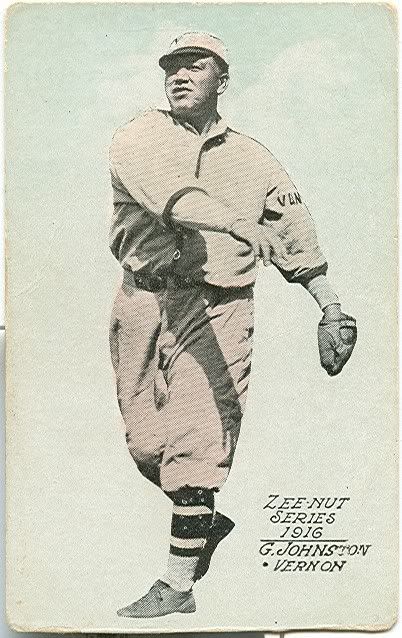
For example, one of the most significant cases of the year involved pitcher George "Chief" Johnson (pictured), who defected to the Federal League in April 1914 following a dispute with his prior team, the Cincinnati Reds. The Reds immediately secured a temporary injunction in Illinois state court to prevent Johnson from making his Federal League debut in Chicago during the inaugural game at Weeghman Park, better known today as Wrigley Field. By the time Cincinnati's attorneys reached the ballpark, however, the game had already begun, so Johnson was served with the court papers when walking off the field after the second inning.
The court eventually held a hearing several weeks later to decide whether to issue a permanent injunction preventing Johnson from playing for his new team. The Federal League was so confident it would ultimately prevail in the Johnson case that it reportedly arranged for as many as thirty-seven major league players to jump to the new league should it receive a favorable decision from the Chicago court. Unfortunately for the Federals, however, the state court judge issued a permanent injunction on June 3, 1914, upholding the standard player contract Johnson had signed with the Reds, on the basis that it must have been fair in light of the number of players who had voluntarily agreed its terms. Although this decision would be overturned on appeal several weeks later -- allowing Johnson to resume his Federal League career -- the damage had been done, as the Federal League's planned raid of the major leagues fell apart following the trial court decision.
While the initial decision by the Johnson court was a significant set-back for the Federal League, the parties ultimately battled to a draw in their 1914 litigation efforts, with both sides winning several important decisions. Perhaps more significantly, these lawsuits also set the stage for the next major phase of the Federal League's legal challenge to the major leagues, namely the federal antitrust lawsuit it filed with Judge Kenesaw Mountain Landis in 1915 (to be discussed in my next post).
Senin, 10 Februari 2014
Minggu, 09 Februari 2014
Baseball on Trial: The Origin of Baseball's Antitrust Exemption
I recently spent the better part of a year and a half researching and writing a book documenting the history of the 1922 U.S. Supreme Court case of Federal Baseball Club of Baltimore v. National League, the litigation that gave rise to baseball's antitrust exemption. I am happy to announce that the book, titled Baseball on Trial: The Origin of Baseball's Antitrust Exemption (from the University of Illinois Press), has been released and is now available for purchase.
Baseball on Trial draws upon a variety of original source materials, including the original court records from the litigation, contemporaneous newspaper accounts, and a recently released collection of attorney correspondence from the case available at the National Baseball Hall of Fame Research Library in Cooperstown, New York. Not only does the book document the history of the Federal Baseball lawsuit itself, but it also covers the many precursor cases arising out of the Federal League challenge to Major League Baseball in 1914 and 1915, litigation which in many ways set the stage for the Supreme Court proceedings. Through a series of posts over the next several days, I'll be summarizing some of the more interesting findings from my research.
In the meantime, here is the publisher's official description of the book:
Baseball on Trial draws upon a variety of original source materials, including the original court records from the litigation, contemporaneous newspaper accounts, and a recently released collection of attorney correspondence from the case available at the National Baseball Hall of Fame Research Library in Cooperstown, New York. Not only does the book document the history of the Federal Baseball lawsuit itself, but it also covers the many precursor cases arising out of the Federal League challenge to Major League Baseball in 1914 and 1915, litigation which in many ways set the stage for the Supreme Court proceedings. Through a series of posts over the next several days, I'll be summarizing some of the more interesting findings from my research.
In the meantime, here is the publisher's official description of the book:
The controversial 1922 Federal Baseball Supreme Court ruling held that the "business of base ball" was not subject to the Sherman Antitrust Act because it did not constitute interstate commerce. In Baseball on Trial, legal scholar Nathaniel Grow defies conventional wisdom to explain why the unanimous Supreme Court opinion authored by Justice Oliver Wendell Holmes, which gave rise to Major League Baseball's exemption from antitrust law, was correct given the circumstances of the time.
Currently a billion dollar enterprise, professional baseball teams crisscross the country while the games are broadcast via radio, television, and internet coast to coast. The sheer scope of this activity would seem to embody the phrase "interstate commerce." Yet baseball is the only professional sport--indeed the sole industry--in the United States that currently benefits from a judicially constructed antitrust immunity. How could this be?
Using recently released documents from the National Baseball Hall of Fame, Grow analyzes how the Supreme Court reached this seemingly peculiar result by tracing the Federal Baseball litigation from its roots in 1914 to its resolution in 1922, in the process uncovering significant new details about the proceedings. Grow observes that while interstate commerce was measured at the time by the exchange of tangible goods, baseball teams in the 1910s merely provided live entertainment to their fans, while radio was a fledgling technology that had little impact on the sport. The book ultimately concludes that, despite the frequent criticism of the opinion, the Supreme Court's decision was consistent with the conditions and legal climate of the early twentieth century.
"[A] thoughtful and provocative analysis of one of the most controversial topics in sports law: Baseball's antitrust exemption. Grow adroitly connects recent disclosures from the Baseball Hall of Fame to advance his argument that the Federal Baseball holding made much more sense ninety years ago than contemporary commentators tend to regard it. As baseball's antitrust exemption continues to face legal challenges--including whether the Oakland A's can move to San Jose--Grow's book will undoubtedly play an influential role." -- Michael McCann, Sports Illustrated legal analyst
"The lawsuits arising from the Federal League's challenge to Major League Baseball and their aftermath defined much of the way baseball has evolved over the past century. Bolstered by original research, Grow explains both the broader picture and the intriguing behind-the-scenes machinations, and he does so in a clear and entertaining fashion." -- Daniel R. Levitt, author of The Battle that Forged Modern Baseball: The Federal League Challenge and Its Legacy
"An outstanding book based on previously unused materials, Baseball on Trial makes a truly significant contribution to the fields of baseball and the law, sports law, antitrust law, and legal history. Anyone discussing the trilogy of Supreme Court cases that created baseball's antitrust exemption needs to read this book." -- Edmund P. Edmonds, co-editor of Baseball and Antitrust: The Legislative History
Jumat, 07 Februari 2014
Supply and Demand on National Signing Day
Wednesday was "National Signing Day" -- a day that has become an unofficial holiday of sorts for college football and its consumers. The media coverage of the signings of Four and Five-Star recruits on this day just becomes more intensified each year. Indeed, National Signing Day has all the resemblances of Draft Day in professional sports: The "war rooms," the depth charts, the last minute decisions, the last minute faxes, the high stress, the high fives, and all the uncertainty of which teams are going to get the top players available in the class.
But what I see on this particular day each year is a huge demand for a very small supply of people who possess unique and extraordinary skills and whose performances are necessary for the product of major college football to exist. Unlike the rest of us in this world, these elite athletes are not fungible (replaceable) and, thus, their market value is increasing each year along with the exponentially increasing revenues generated by the industry.
The current conversation surrounding the threat to "amateurism" is fixated on the legality of NCAA rules and whether the NCAA and its members can prevail in court and, as of two weeks ago, in front of labor relations boards. But perhaps we are grossly underestimating the leverage possessed by these elite athletes as well as the practicality of their ability to collectively demand and obtain, outside of the boundaries of the legal system, more rights and benefits from their universities in exchange for their willingness to show up and perform for us on Saturdays. In other words, the biggest threat to "amateurism" is likely going to be basic economic principles of supply and demand.
In conjunction with a symposium last fall at the University of Mississippi School of Law, I wrote a paper discussing these issues and it will be published soon in the Mississippi Sports Law Review. The paper is titled, "The Battle Outside of the Courtroom: Principles of "Amateurism" vs. Principles of Supply and Demand," and can now be downloaded from the SSRN link here.
But what I see on this particular day each year is a huge demand for a very small supply of people who possess unique and extraordinary skills and whose performances are necessary for the product of major college football to exist. Unlike the rest of us in this world, these elite athletes are not fungible (replaceable) and, thus, their market value is increasing each year along with the exponentially increasing revenues generated by the industry.
The current conversation surrounding the threat to "amateurism" is fixated on the legality of NCAA rules and whether the NCAA and its members can prevail in court and, as of two weeks ago, in front of labor relations boards. But perhaps we are grossly underestimating the leverage possessed by these elite athletes as well as the practicality of their ability to collectively demand and obtain, outside of the boundaries of the legal system, more rights and benefits from their universities in exchange for their willingness to show up and perform for us on Saturdays. In other words, the biggest threat to "amateurism" is likely going to be basic economic principles of supply and demand.
In conjunction with a symposium last fall at the University of Mississippi School of Law, I wrote a paper discussing these issues and it will be published soon in the Mississippi Sports Law Review. The paper is titled, "The Battle Outside of the Courtroom: Principles of "Amateurism" vs. Principles of Supply and Demand," and can now be downloaded from the SSRN link here.
Rabu, 05 Februari 2014
More fun with sports rules, Basketball edition
Here is a fun one: In the NBA, if a player picks up his sixth foul when his team only has five remaining, the player is not out of the game. He continues playing, although a technical foul is called on the sixth and every subsequent foul he commits. The rule allowed the Lakers' Robert Sacre to continue playing in a game the Lakers ultimately won; the team had only dressed eight players, two got hurt, and one fouled out before Sacre did.
Naturally, someone raised the question of how the rule might be manipulated--could every player on the team suddenly be "injured," allowing the star to keep playing if he fouls out?
Senin, 03 Februari 2014
4th Annual Duke Law School's Sports & Entertainment Symposium
Duke Law School will be hosting their 4th Annual Sports & Entertainment Symposium.
When: February 7, 2014 (all day)
Where: Duke Law School, Room 3041
Additional details can be found here.
Topics Include:
* The Film Industry in the South
* The Law of Sports Betting
* Structuring Complex Sports Transactions
* Copyright Law & User-Generated Video Content
* O'Bannon & The Debate Over Pay
* Entertainment Law Panel
* Painkillers in Professional Football
Panelists Include Sports Law Blog's Founder, Greg Skidmore (Kirkland & Ellis), as well as the blog's Gabe Feldman (Tulane) and Warren K. Zola (Boston College). Other noted sports lawyers appearing include: Paul Haagen (Duke), Alan Fishel (Arent Fox), Christian Dennie (Barlow, Garsek & Simon), Mark Strothcamp (NCAA), Bo Moon (Bloomberg Sports), Curt Clausen (Skadden Arps), & John Hogan (John Hogan Law).
Football and the Infield Fly Rule
My essay, Football and the Infield Fly Rule, is now up on UCLA L. Rev. Discourse. The piece discusses football situations and rules that rely on the same internal logic and cost-benefit analysis as the Infield Fly Rule. And the online format let us embed some audio and video. The editors were good enough to push the schedule so we could publish the day after the Super Bowl.
Had any interesting rule-based plays happened yesterday, I might have written a follow-up here. Alas, the best the game gave was back-to-back Super Bowl safeties--the last score of SB XLVII and the first score of SB XLVIII. Someone won an interesting prop bet (although apparently not Mark Cuban).
Sabtu, 01 Februari 2014
Against (some) slow-motion replay
This Slate story discusses the work of Zach Burns, a psychologist in the business school at Northwestern, who argues against using slow-motion replay to judge intent in sports, such as for fine-worthy hits, flagrant fouls, etc. Slowing something down affects perception, makes it appear that the built-up to the conduct, and makes viewers more likely to find that someone acted with evil intent. Burns does say that replay is fine for judging actions, such as whether someone crossed a line, although it seems to me we'll likely see the same skewing of perception.
Langganan:
Postingan (Atom)